Veteran metal band Demon Hunter has filed a trademark infringement lawsuit against Netflix and AEG Presents, alleging the entertainment giants have overwhelmed the group’s 25-year-old brand while transforming the hit animated film KPop Demon Hunters into a sprawling music, merchandise and live-entertainment franchise.

In a complaint filed Tuesday in federal court in Los Angeles, Demon Hunter’s corporate entity, Hyde Lane Inc., accused Netflix, Netflix Studios and AEG of creating both conventional and “reverse” consumer confusion by using the KPop Demon Hunters name across recordings, clothing, printed merchandise and, most recently, a planned global concert tour.
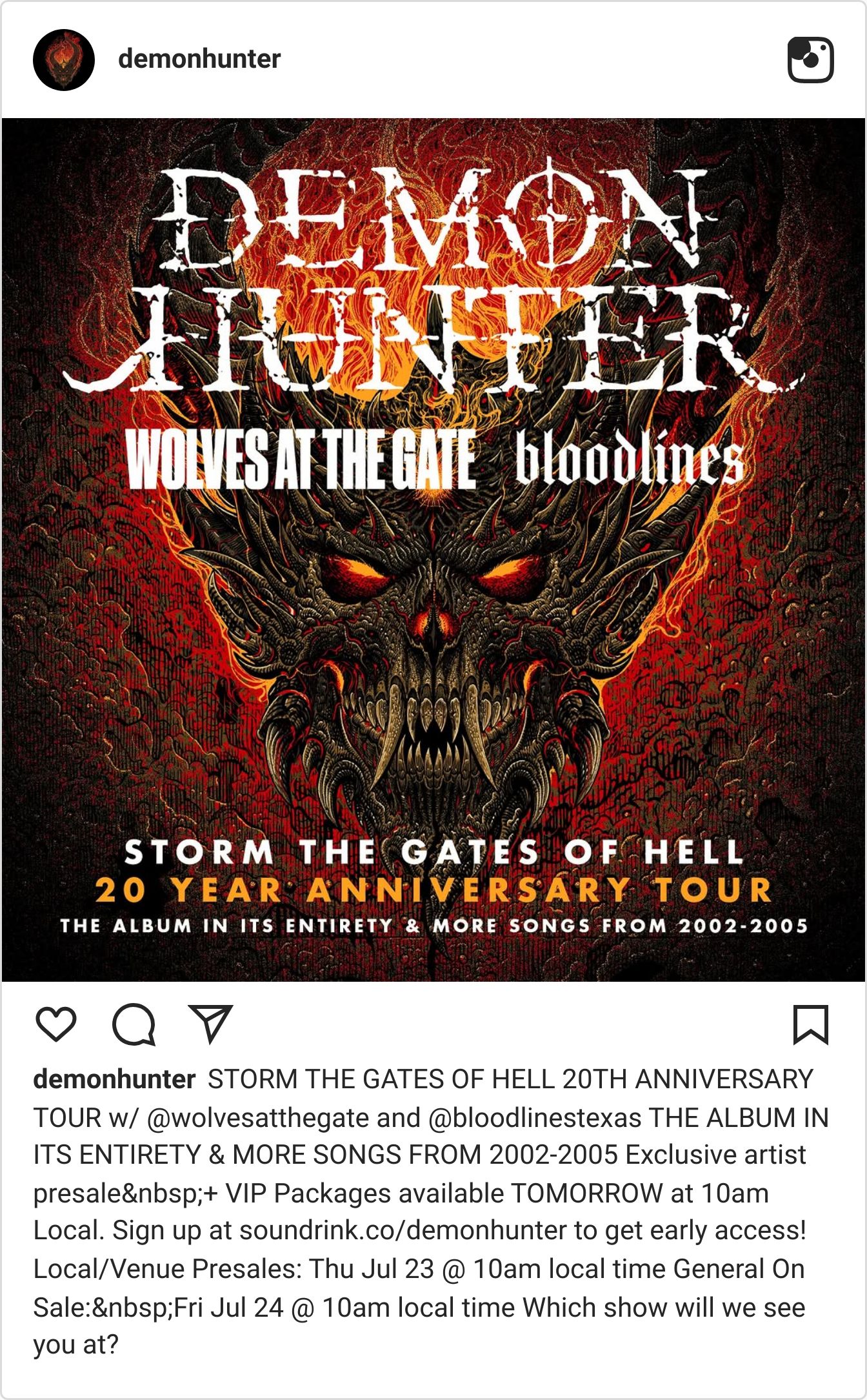
Instagram post

The lawsuit claims that Netflix’s expansion into live entertainment has pushed the two brands into “almost complete overlap,” threatening Demon Hunter’s ability to control the name it has used since 2001.

“This lawsuit is a classic case of massive companies that jealously guard and enforce their own intellectual property rights willfully disregarding the rights of others in pursuit of profits,” attorneys for Hyde Lane wrote in the 46-page complaint.

The band is seeking an injunction that could prevent Netflix and AEG from using the KPop Demon Hunters name in connection with music, merchandise and live concerts. It is also asking for Netflix’s profits from the allegedly infringing activity, triple damages, punitive damages, corrective-advertising expenses and an order directing the U.S. Marshals Service to seize infringing products.

The allegations have not been proven in court. Netflix and AEG had not filed responses to the lawsuit as of Tuesday.

Instagram post

From Streaming Hit to Concert Tour

Demon Hunter was formed in Seattle in 2000 by brothers Ryan and Don Clark. The Christian metal band released its first single, “Through the Black,” in 2002 and has since released more than a dozen albums, including 2025’s There Was a Light Here.

According to the complaint, Demon Hunter has sold more than 1 million albums and streaming-equivalent albums in the United States, performed more than 300 major concerts and appeared at festivals alongside Ozzy Osbourne, KISS, Foo Fighters, Guns N’ Roses and Alice Cooper.

Hyde Lane owns three federal registrations for the DEMON HUNTER mark covering recorded music, printed materials and clothing. Those registrations were issued in 2022 but claim commercial use of the name dating back to 2001 and 2002.

The company also previously held a registration covering live performances by a musical band. That registration was canceled in February 2025 after Hyde Lane inadvertently failed to file required renewal paperwork, according to the lawsuit. Hyde Lane filed a new application covering live music and concert services in December.

Netflix released KPop Demon Hunters in June 2025. The film follows a fictional K-pop girl group whose members use their music and supernatural abilities to protect the world from demons.

The movie and its soundtrack became enormous hits. Citing figures published by Netflix, the complaint says the film generated more than 325 million views, while its soundtrack surpassed 10 billion global streams and became the first soundtrack to place four songs in the Billboard Hot 100’s Top 10 simultaneously.

Netflix then expanded the franchise through clothing, albums, paper products and other merchandise sold through the Netflix Shop and third-party licensees.

The dispute escalated in May, when Netflix announced that it was partnering with AEG Presents to launch a KPop Demon Hunters global concert tour reportedly expected to reach approximately 150 cities. The announcement followed a surprise performance connected to the property at the AEG-owned Coachella Valley Music and Arts Festival.

For Demon Hunter, the move into concerts allegedly eliminated what remained of the commercial separation between the two properties.

“In just a year’s time, Defendants have taken step after step to move into almost complete overlap with the goods and services offered by Hyde Lane under the DEMON HUNTER mark,” the lawsuit states.

A $500 Ticketing Mistake

Hyde Lane’s complaint includes several examples that it says demonstrate actual confusion—not merely the possibility that consumers could mistake one property for the other.

In one incident, a parent allegedly spent nearly $500 on tickets to Demon Hunter’s May 2 concert in Albany, New York, believing the tickets were for a child-friendly KPop Demon Hunters show.

The parent contacted the band in February and explained that the tickets had been intended for his 5- and 6-year-old daughters.

“I realized that you guys are not ‘K Pop demon hunters’ and that my 5 and 6yr old girls will probably not fit in well at your concert,” the parent wrote, according to an email reproduced in the complaint. “I thought I was purchasing tickets to a child friendly concert.”

In a separate episode, an Inside Edition producer allegedly contacted Demon Hunter’s manager seeking an interview with Yu-Han Lee, a songwriter associated with KPop Demon Hunters, after Lee won an Oscar. Lee has no connection to the metal band.

The lawsuit also points to social-media posts tagging Demon Hunter in content about the Netflix film, search results that mix the two brands and Ticketmaster listings that allegedly prioritized KPop Demon Hunters-related events when users searched for “Demon Hunter.”

Hyde Lane argues that the confusion works in two directions. Some consumers may believe Netflix’s products or concerts are connected to the band, which trademark law describes as forward confusion. Others may encounter Netflix’s much larger franchise first and conclude that the long-established metal band is affiliated with—or copied from—Netflix.

That second theory, known as reverse confusion, is central to the case.

Because Netflix has vastly greater financial and promotional resources, Hyde Lane argues, the newer KPop Demon Hunters brand is capable of eclipsing Demon Hunter in the marketplace even though the band began using its name more than two decades earlier.

“Defendants’ greater size and strength overwhelms Hyde Lane’s established identity,” the complaint alleges, causing consumers to perceive the band as “affiliated with, sponsored by, or derived from Defendants.”

Is ‘KPop’ Enough to Separate the Names?

A major question in the case will be whether the addition of the word “KPop,” combined with the plural “Hunters,” sufficiently distinguishes Netflix’s title from the band’s DEMON HUNTER trademark.

Hyde Lane argues it does not.

The lawsuit characterizes “KPop” as a generic—or, at most, descriptive—term for a genre of music. It cites decisions by a U.S. Patent and Trademark Office examiner who declined to treat “KPop” as an inherently distinctive part of one Netflix trademark application.

According to the complaint, the examiner concluded that “KPOP” merely described a feature or characteristic of Netflix’s entertainment services and told Netflix Studios it could proceed by disclaiming any exclusive right to that portion of the name.

Hyde Lane argues that leaves “DEMON HUNTERS” as the meaningful and potentially protectable portion of Netflix’s proposed trademark—and therefore the portion most similar to the band’s name.

“Netflix is no more entitled to use the mark KPOP DEMON HUNTERS than it would be to launch a recording artist, live touring show and merchandise under the marks KPOP METALLICA, KPOP U2 or KPOP BLACK SABBATH,” the complaint states.

Netflix is likely to contest that analysis and could argue that audiences understand KPop Demon Hunters as the title of a specific animated film rather than as a reference to Demon Hunter. Titles of expressive works can also receive First Amendment protections, although those protections may become more complicated when a title is used broadly as a consumer brand for merchandise and live entertainment.

Hyde Lane’s case is aimed primarily at those commercial extensions. The complaint focuses less on Netflix’s right to distribute the film than on its use of the name to sell recordings, clothing and concert experiences competing in the same categories covered by Demon Hunter’s trademarks.

An Attempt to Stop the Tour

The complaint asserts four causes of action: federal trademark infringement, false designation of origin and statutory and common-law unfair competition under California law.

The band is asking the court to preliminarily and permanently block the defendants from using KPop Demon Hunters, or any confusingly similar name, on recorded music, printed goods, clothing and live music events.

It also wants the court to cancel or order the abandonment of Netflix’s conflicting trademark applications and registrations.

The requested injunction against live events applies to all the defendants, including AEG, potentially placing the planned global tour directly in the lawsuit’s crosshairs. Netflix and Netflix Studios are separately targeted over recordings and merchandise.

The case represents a high-stakes test of what happens when a globally successful entertainment property collides with a smaller but much older music brand. Demon Hunter’s lawyers argue that trademark priority cannot simply be erased by Netflix’s superior reach, spending power and cultural visibility.

“Due to Defendants’ wrongful actions,” the complaint states, “Demon Hunter’s established identity is becoming increasingly obscured within recorded music, live touring and merchandise-related channels.”

For a band that has spent a quarter-century building its name, the lawsuit argues, Netflix’s franchise is no longer merely a similarly titled movie. It is now a recording project, merchandise line and touring production operating in essentially the same commercial territory—and threatening to turn the original Demon Hunter into the brand consumers believe came second.

Recommended for you

View all
caret-right